Columbus Pride 2026: Our Voices, Our City- (Part 7)-Beyond the Rainbow: Inside the Columbus LGBTQ+ Affairs Commission’s Deep-Dive Structural Battle Against Isolation, Homelessness, and Statehouse Bureaucracy
- Rainbow_Rocks
- July 1, 2026
- Creative Work, Editorial Features, Entertainment
- #ColumbusOhio, #IndependentJournalism, #RainbowRocks, Adam Cogar, Blain G Saito, Columbus City Council President Shannon Hardin, Columbus LGBTQ+ Affairs Commission, Dr Jasmine Roberts Crews, Jamie Luby Lenzo, Jonathon Kielholtz, Julia Applegate, LGBTQIA+, Peaches Calhoun, Rainbow Rocks, Riley Williamson, Rob Leis, Siobhan Boyd Nelson, Thomas Savage, Tyson Crenshaw
- 0 Comments
Written By Rainbow: June 30th, 2026
COLUMBUS, OH — The room sat in a dense, emotionally fragile silence. A mother had just finished speaking, her voice fracturing under the weight of tears as she detailed her child’s daily struggle to survive in a local middle school. Up at the front dais, Commissioner Jaylah Hollins—a black trans woman and lifelong resident of Columbus—leaned in, her eyes locked on the speaker.
“Thank you for sharing your story,” Hollins said, validation cutting through the thick tension of the chamber. “Growing up here, I unfortunately didn’t have the privilege of coming from an accepting family. I had to find that for myself outside of my family, in a community, and sometimes doing that can feel extremely vulnerable. You don’t know who you may run into, or who you might feel targeted by entirely… Being here on this commission and listening to stories where I see myself—it’s crucial. I’m very glad to see your faces in this room, and I’ll be even more glad when the podiums are filled.”
This wasn’t a standard, sterile public hearing designed to satisfy an administrative requirement. There were no rehearsed, generic talking points or slick, dismissive bureaucratic platitudes. This was the inaugural public Listening Session for the newly formed Columbus LGBTQ+ Affairs Commission.
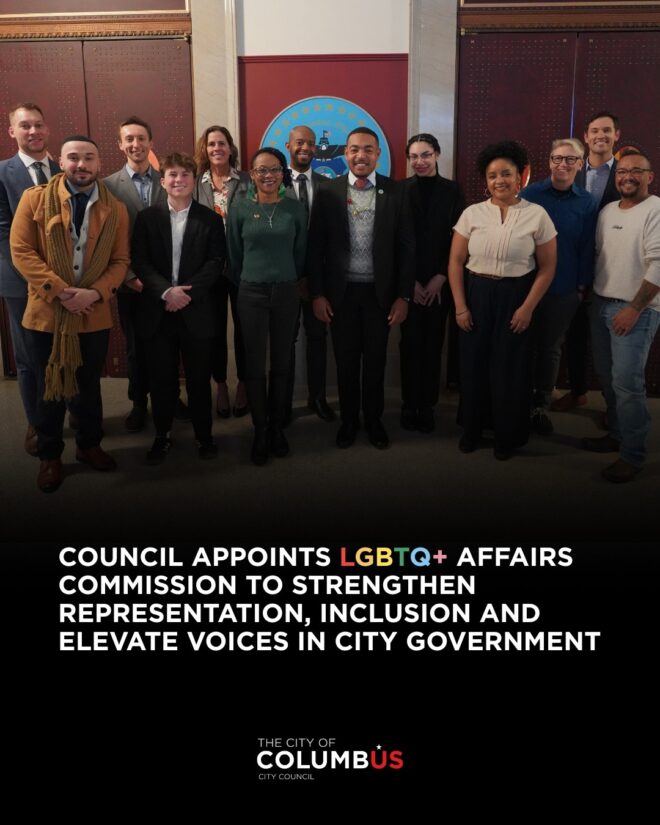
Back in July of last year in 2025, City Council passed the official ordinance establishing this 13-member volunteer advisory board, which was promptly signed by Mayor Andrew Ginther. Following a public call for applications, the commissioners were chosen and notified in December. Now, they are tasked with an immense, unprecedented local mandate: constructing a grassroots municipal advocacy pipeline from the pavement up. Or, as Commission Chair Dr. Jasmine Roberts Crews plainly described it, building a foundation from “ground zero.”
But if anyone in the higher echelons of city governance expected this new body to act as a superficial public relations campaign draped in a seasonal pride flag, Dr. J dismantled that illusion within the opening minutes of the session.
“Y’all, we are not just rainbows, you know that, right? We are human beings who just want to live our lives with dignity. I think it’s important that we attach a real human being to these issues.” — Dr. Jasmine Roberts Crews, Commission Chair
Part I: The Anatomy of a New Kind of Commission
The Columbus LGBTQ+ Affairs Commission enters the municipal landscape at a time when the intersection of local governance, state legislation, and grassroots survival has never been more strained. To understand the stakes of this inaugural listening session, one must first look at the unique, decentralized nature of the body itself.
The panel is completely uncoupled from the city’s official payroll. They are not career politicians, nor are they insulated bureaucratic staffers looking to climb an administrative ladder. They are localized block residents, high school educators, community organizers, human resource specialists, and non-profit managers who volunteered to step directly into the crosshairs of public service.
Meet the Commissioners: The Faces Behind the Mandate
When Dr. J paused the official agenda to ask her fellow commissioners to state their names, pronouns, subcommittee alignments, and personal motivations—their “why”—the panel transformed from an anonymous administrative unit into a vivid, complex cross-section of Columbus’s social reality.
- Dr. Jasmine Roberts Crews (Chair, Executive Committee): A black bisexual woman, community advocate, and university communication professor. She candidly shared that watching the continuous, multi-tiered political onslaught against queer, trans, black, and brown communities over the past several years had left her feeling profoundly overwhelmed and demobilized. Joining the commission was a conscious act to “revitalize my advocacy spirit” and construct a functional, institutional mechanism to strike back.
- Thomas Savage (Vice Chair, Executive Committee): Appointed jointly by the City Council President and the Mayor. Savage emphasized that while the commission was structurally initiated by city ordinances, its operational soul belongs entirely to the pavement. He highlighted that the body features a diverse array of life stages, from active undergraduate students to seasoned trans elders.
- Peaches Calhoun (Executive Board, Advocacy & Policy Chair): A prominent neighborhood servant who lives and breathes local advocacy on the city’s East Side, balancing five years of service on her local area commission alongside raising four children. For Peaches, the commission is a tool to democratize legislative literacy, stripping away clinical legal terminology so the average working-class resident can track, understand, and combat hostile statehouse bills.
- Rob Leis (Health & Human Services Committee): A lifelong learner who expressed that holding a seat on a municipal advisory body carries an inherent responsibility to leverage his structural privilege to directly serve those left behind by city systems.
- Siobhan Boyd Nelson (Community Engagement, Communications, & Outreach Committee): A lifelong Columbus resident whose parents were also born and raised in the city. Boyd Nelson grounded the session in deep historical context, noting that the commission’s existence is the direct result of decades of grueling, multi-generational street work by local pioneers who fought through the 1970s, 80s, and 90s to anchor a queer political foothold in Ohio.
- Tyson Crenshaw (Community Engagement, Communications, & Outreach Committee): A community leader who commanded the immediate, absolute attention of the chamber. “I am a trans elder,” Crenshaw stated, allowing the gravity of the designation to fill the room. “Soak that in for a minute because you’re not going to hear it often. As a person of color, as a trans elder, it is imperative that I take the opportunity to sit in a space, have a place at the table for those coming after me, and let them know that there is hope. I’m still here, and we’re banging on doors.”
- Julia Applegate (Health & Social Services Chair): A long-term resident who has spent her entire adult life navigating the city’s social structures. When asked earlier that day what brought her to the city decades ago, her response was swift: “It was because of the lesbians, and that’s why I’ve stayed here.” Applegate’s commission priority centers on structural health equity across the total human lifespan, with a dedicated focus on aging well, elder longevity, and social safety nets for older queer residents.
- Jamie Luby Lenzo (Health & Social Services Committee): A dedicated parent of two young trans individuals. While validating that Columbus has historically cultivated a progressive, supportive environment relative to the broader region, Lenzo stated plainly: “I want more as a mom. We need more as a community, but this is a great first step.”
- Adam Cogar (Health & Human Services Committee): An HR professional with a master’s degree who migrated from West Virginia to Columbus in 2006 to seek the refuge the city’s non-discrimination policies promised. Koger revealed that fresh out of college, he was abruptly fired from his very first professional job simply because of his sexual orientation—a systemic vulnerability that many young people mistakenly believe is universally illegal, but remains tragically permissible in many jurisdictions.
- Jonathan Kielholtz (Outreach, Engagement, & Communication Committee): A former print and broadcast journalist who spent years documenting local and national headlines tracking funding rollbacks for critical queer healthcare. Kielholtz reflected on his own childhood spent navigating a conservative Catholic school environment in isolation, terrified to step out of the closet. His motivation is rooted in shifting municipal policy so that no child in the city has to grow up under the shadow of institutional fear.
Not Present: Columbus LGBTQ+ Affairs Commissioners Blaine G Saito and Riley Williamson.
Part III: The Community Floor — Confronting Material Class and Access Barriers
When the formal presentations concluded and the floor opened up to public comments, the polished aesthetics of a city hall forum dissolved. In its place emerged a raw, unfiltered catalog of the material hurdles of being queer, trans, working-class, or unhoused in a midwestern urban center.
1. Breaking the Non-Profit Jargon and Physical Barriers
The public dialogue began with a sharp challenge regarding community engagement. An audience member named Miss Ellen called out the empty chairs in the room, demanding to know what active steps the commission was taking to ensure notice of these hearings reaches everyday working people who aren’t deeply entrenched in political circles.
The query sparked an immediate defense of proactive organizing from Commissioner Crenshaw: “I need you to show up. I don’t need community reactive. This is proactive stuff. We’re here to be proactive. Come out. I challenge you, come out. There’s enough of us together; we’ll have a good time. But let’s start by showing up.”
However, subsequent speakers quickly illuminated that the absence of residents isn’t a symptom of community apathy, but rather a direct consequence of structural roadblocks built into city architecture. Joseph Sosa pointed out a glaring irony: to even enter the municipal building to attend a session about marginalized accessibility, a resident must present a state-issued photo ID to security. This requirement instantly alienates or bars undocumented individuals, trans residents whose IDs don’t match their gender presentation, and unhoused people who may lack up-to-date state credentials.
Sosa, along with several other attendees, implored the commission to abandon the formal city chambers for public sessions and intentionally decentralize their presence. They pushed for future meetings to occur directly within trusted, neighborhood-specific communal spaces across the city—such as Linden or the South Side near Franklin Park—where public transportation gaps and socioeconomic isolation prevent working-class residents from commuting downtown.
Beyond physical transit, an attendee from the non-profit camp sector raised a critical point about language barrier mechanics, highlighting how academic and professionalized non-profit vocabulary isolates the very people these organizations claim to support:
“The thing I hate the most is that we speak in nonprofit language, which people don’t understand. If you’re someone who’s working three jobs and barely making it by, and then you hit me with ‘legislative process’ or complex regulatory talk, you already lost me there. Friendlier language, understanding that Ohio has a third-grade reading level on average… really meeting people exactly where they are at is crucial.”
2. Left-Behind Youth and the Crisis in Public Classrooms
The emotional center of the session arrived when Andy Davenport shared the immediate, daily terrors confronting her 13-year-old non-binary pansexual child. Davenport revealed that her child confessed to eating lunch entirely in isolation every single day, unable to find a safe social pocket to inhabit.
Davenport then detailed an administrative nightmare: following a wave of state-level policy rollouts and statehouse pressures, her child’s friends arrived at school to find their records altered without warning—forcefully reverted to their dead names on official school rosters.
“It was devastating,” Davenport said, her voice shaking as she addressed the dais. “My child has me to look up to. But there’s a lot of youth here that don’t… How can we present you to the youth community? Because they can look up to you and see what goals they can reach.”
This testimony triggered painful personal reflections from educators on the ground. Jonathan Pope, a high school teacher at Walnut Ridge High School, stepped forward to remind the commission that the teenagers most vulnerable to structural violence are completely severed from mainstream LGBTQ+ non-profits and downtown resources:
“I deal with high school youth at Walnut Ridge that are queer, trans, non-binary—and those are youth that come from backgrounds where they don’t even necessarily have the language to describe a lot of their experiences. I’ve seen students that will show up in a wig one day during the year, and they’re like, ‘I’m not even asking teachers to change my pronouns. I’m just trying to survive. I’m trying to move through this world and navigate.’
Keeping those youth in mind when we’re talking about visibility… because these are the kids that aren’t going to Stonewall. They don’t even know what Kaleidoscope is. They often are the ones that just are never reached.”
Corey Baker, another local educator, backed Pope’s observations, stating that while institutional resources exist for teachers, their marketing is severely deficient. He pressed the commission to operate as a rapid-response translation mechanism that explicitly outlines how abstract statehouse bills directly impact student safety inside neighborhood classrooms.
3. The Unhoused, Section 8, and the Danger of Blind Funding Metrics
The structural dialogue consistently returned to survival needs: housing stability, employment discrimination, and data tracking. Ryan Hubble, a resident of the South of Main neighborhood near Franklin Park, commended the body for keeping class consciousness at the center of its agenda, noting that in the current economic climate, residents are struggling to lock down foundational necessities like stable housing and groceries.
A representative from Stonewall Columbus brought a staggering statistic into the record: there is an estimated population of 1,000 to 1,500 queer and trans youth currently surviving on the streets of Franklin County. Many of these youth are unhoused because they were discarded by unaccepting guardians.
Under current federal guidelines, proving homelessness or accessing emergency municipal resources often requires navigating bureaucratic frameworks that demand guardian verification—a legal catch-22 that traps youth on the street. The representative strongly urged the commission to pressure the Community Shelter Board to modify HUD’s annual Point in Time (PIT) homelessness count survey in January to include explicit fields for sexual orientation and gender identity:
“The PIT count is a point-in-time count that the Community Shelter Board organizes where we count all of our homeless population, and we do this very lengthy survey that informs how the agency runs with the goal of serving the community better. I think one thing that would be great to add to this survey is questions regarding sexual orientation and identity… because it does intersect into how folks receive services, particularly regarding housing… We receive a lot of unhoused community members through our doors, and we need to better understand what our community needs from the most vulnerable of people.”
Chair Dr. Jasmine Roberts Crews immediately connected this data gap to an ongoing structural critique occurring within the commission’s internal review of city finances:
“As we were looking at a funding memo that was put together for us, we realized that some of the funding that is allegedly allocated to the LGBTQ+ community—it’s not put together through the lens of queerness, if that makes any sense. So there might be some funding for general housing, and then there’s an administrative assumption that, ‘Okay, well, LGBTQ+ people are going to benefit from that.’ No, no, no, we don’t know that if there is not a specific lens that we’re using to actually think through how we allocate that funding.”
Furthering the housing discussion, residents pushed for the commission to recommend explicitly enshrining protections against housing and employment discrimination based on sexual orientation and gender identity directly within the City Charter as a permanent amendment, ensuring that no shifting political tide could erode local protections for section eight or public housing tenants.
Part III: The Accountability Blueprint
Recognizing the historically valid skepticism of an audience weary of symbolic government panels, the commission dedicated the final phase of the session to outlining clear, measurable markers of accountability. Dr. J explicitly stated that this session would not end with stories being gathered, filed away, and forgotten.
The commission’s explicit strategic workflow for the upcoming calendar year has been organized into four distinct operational pipelines:
[Community Listening Session Testimony]
                 │
                 ▼
┌────────────────────────────────────────────────────────┐
│  1. THE "WHAT WE HEARD" SYNTHESIS REPORT               │
│     - Verify raw testimonies with residents            │
│     - Define specific policy targets                   │
└────────────────────────┬───────────────────────────────┘
                         │
                         ▼
┌────────────────────────────────────────────────────────┐
│  2. DIRECT LEGISLATIVE INTERVENTION                    │
│     - Quarterly face-to-face City Council brief        │
│     - Draft resolutions on health/housing equity       │
└────────────────────────┬───────────────────────────────┘
                         │
                         ▼
┌────────────────────────────────────────────────────────┐
│  3. DECENTRALIZED NEIGHBORHOOD PENETRATION             │
│     - Move public forums to Linden & South Side And
                    Neighborhoods
│     - Deploy non-digital print flyer networks          │
└────────────────────────┬───────────────────────────────┘
                         │
                         ▼
┌────────────────────────────────────────────────────────┐
│  4. DATA-DRIVEN INTERACTION REFORM                     │
│     - PIT homelessness survey modifications
│     - Audit general municipal fund allocations         │
└────────────────────────────────────────────────────────┘
The Long-Term Horizon: Protecting the Most Vulnerable
To establish a clear framework for transparency, the commission highlighted the distinct functions of its subcommittees—such as Peaches Calhoun’s Advocacy & Policy group and Julia Applegate’s Health & Social Services team—which stream their working sessions live on the city’s public portals. This ensures that the community can witness the exact transition of public testimony into formal advisory resolutions.
Additionally, addressing the digital divide and mental health concerns that cause residents to log off corporate social media networks, the commission committed to deploying old-school, analog print flyers and physical resource postcards across local coffee shops, independent bookstores, and venues like Cafe Kerouac to make sure public notices reach the physical streets.
Before closing out the session and stepping down from the dais to speak one-on-one with the remaining attendees, Dr. J re-anchored the body’s ultimate measure of structural success:
“Whatever work we end up focusing on—whether it’s housing policy, education, or resource allocation—I want to make sure that we are advocating directly for the most marginalized within the LGBTQ+ community. That is what success looks like for me. I’m talking about trans people of color, queer people of color, our elders, and of course, our queer youth. We cannot assume that a policy that perhaps works for a cisgender white gay man is going to automatically work for a trans person of color on the street. If we focus on the most marginalized individuals, their lived experiences, and exactly how municipal policy affects them, then every single person in our community will ultimately benefit from that.”
Public Notice & Engagement Directory
For residents looking to track the progress of the commission or speak at upcoming sessions, the body operates under a strict public transparency mandate:
- General Commission Meetings: Held every third Wednesday of each month. These sessions are completely open to the general public, feature dedicated comment windows, and are streamed live via the official city portal.
- Subcommittee Working Sessions: Meeting times, digital access links, and formal legislative trackers are updated regularly on the commission’s dedicated municipal webpage.
- Feedback Submissions: By Email listed here:
“Rainbow is the author and creator behind this. Committed to amplifying LGBTQIA+ voices and pushing through the noise, Rainbow stands by this work. For media inquiries, official commentary, or press statements regarding the response to this article or gallery on RainbowRocks.Space, please reach out to Evan J Thomas PR (EvanJThomasPR@gmail.com)—proudly providing LGBTQIA+-affirming, protective public relations.”